
Carolina Demo & Removal · NC and SC
House & Residential Demolition
- Licensed in NC & SC
- $1M / $2M insured
- Haul-off and dump ticket in the price
Quick quote (888) 643-4199
Get a number for your house demolition job
Name, number and county. We reply with a price range and your permit answer.
Prefer a fast answer? Call (888) 643-4199.
We handle home demolition, residential demolition, building demolition, structure teardown, partial interior demo, including teardown, haul-off and legal disposal, at any address in North Carolina or South Carolina, from a single shed to a full structure.
Typical projects in NC and SC run $6,000 – $25,000 (starting about $4,000). Most residential teardowns land between $4 and $10 per sq ft, with a national average near $14,000. A full basement, contents left inside, or asbestos all move a job up sharply. Exact price, permit jurisdiction and equipment for your site are confirmed per job. Call (888) 643-4199 and we tell you the range before you commit to anything.
What a house demolition job includes
Site visit or photo review, and an honest read on access for machinery.
Disconnect and closure coordination for septic, well and utilities where they apply.
State notifications where required: 10-working-day advance asbestos notice applies to covered demolitions through SCDES (SC) and NC DHHS HHCU (NC).
Teardown, haul-off, and disposal at a legal C&D site, with the receipt.
The job shapes this takes
The house is still full
An occupied or recently cleared house is a different job from a stripped shell. Household contents are billed by the volume hauled, and they are the single largest thing an owner can remove from the quote before anyone arrives. Where the contents have value, say so early: pulling fixtures, doors, hardwood and hardware out to sell or keep is easier before a machine is on the roof than after.
The foundation decides the scope
Crawlspace piers, a slab, a stem wall, or a full basement are four different quantities of breaking, excavating and filling. Many owners choose to break the foundation below grade and cover it rather than remove it, which is a legitimate and much cheaper answer when nothing is being built on the lot. If a new house is going there, full removal is usually what the next foundation wants.
Utilities are still live
Electric has to be disconnected at the pole or the meter and the service drop removed. Water and sewer have to be capped and separated at the main, often with an inspection. Gas gets capped at the meter. None of those is a switch at the breaker panel, and all of them happen before the building comes down.
An old house, or a burnt one
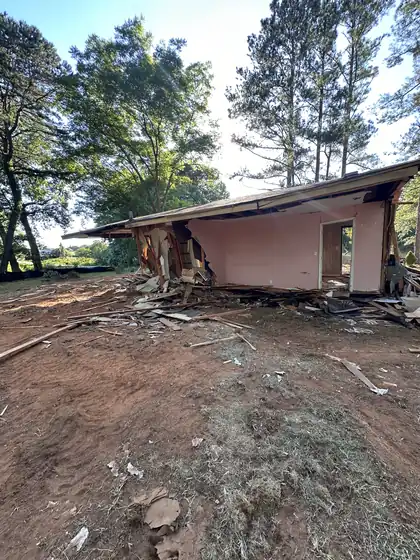
Structures from before the mid-1980s may carry asbestos in floor tile and mastic, pipe wrap, siding and textured ceilings, so testing comes before pricing. A structure that has been through a fire is unstable in ways a sound one is not, and roof members that held water afterwards are heavier and weaker. Both cases change the method, and both are worth stating plainly when you ask for a number.
Before we come, do this
- Clear what you can, and sell or give away anything with value while the walls are still standing.
- Decide what the lot becomes: graded dirt, or builder-ready ground with the foundation gone.
- Find out whether the house is on public water and sewer or on a well and septic, because the second answer adds a health-office step.
- Tell us the approximate build year. It decides whether testing comes first.
- Confirm what a loaded truck can reach, including overhead lines and how the ground behaves after rain.
What is not in the number
Every contractor should be able to say this list out loud. If nobody has told you it before you sign, ask.
- Utility company disconnect and reconnection fees, which belong to the provider and are quoted separately.
- Septic pumping and closure, and well abandonment, which are separate contracts with the county health office.
- Hazardous material testing and abatement, which is priced after a result rather than before one.
- Soil remediation where contamination is actually found, which is a different trade.
- Any zoning variance or hearing requirement, which is the municipality’s process, not a demolition line item.
Where we do this work
Every county in both states. Recent and regular areas include:
- House Demolition in Abbeville, SC
- House Demolition in Anderson, SC
- House Demolition in Arkwright, SC
- House Demolition in Bamberg, SC
- House Demolition in Belton, SC
- House Demolition in Bishopville, SC
- House Demolition in Boiling Springs, SC
- House Demolition in Branchville, SC
- House Demolition in Aberdeen, NC
- House Demolition in Apex, NC
- House Demolition in Atlantic Beach, NC
- House Demolition in Banner Elk, NC
- House Demolition in Bell Arthur, NC
- House Demolition in Bethlehem, NC
- House Demolition in Brices Creek, NC
Before you call about house demolition
Money
What house demolition costs, and what moves it
Paperwork
Who issues your permit, county by county
Trust
Licenses and insurance we will send before you sign
Jobs that usually come with this one
One question comes up on every house demolition job and no one asks it until the truck is loaded: where the material is allowed to go (a site needs a construction and demolition permit to take it), and the eight things that never go in a haul-off (they decide the price before the size does). It is a licensing question more than a distance question, which is why we name the site before the load leaves rather than after.
Quote request with photos (888) 643-4199
Get a number for your job
Give us the best number to reach you and where the structure sits. Add photos if you have them.
Prefer a fast answer? Call (888) 643-4199.