Home demolition in North Carolina typically costs between $5 and $15 per square foot for a standard residential teardown, depending on the home’s size, construction materials, location, and whether hazardous materials like asbestos are present. Most projects take three to ten days from start to finish. A demolition permit is required in nearly all NC jurisdictions, and the contractor handles the application as part of the project.
There’s a point where repairing an old house stops making financial sense. The foundation has shifted, the framing is compromised, the plumbing and wiring need a full replacement, and the renovation estimate starts creeping past what the lot is worth. When you hit that wall, home demolition is the practical next step — clear the structure, clean the site, and start fresh.
Home demolition is also how developers, investors, and land buyers clear aging structures to make way for new construction. Across North Carolina — from older neighborhoods in Charlotte and Raleigh to rural properties in the Piedmont and foothills — residential demolition projects are a routine part of property development and improvement.
This guide covers the full scope of what’s involved: the two main demolition methods, the factors that drive cost, the permit and inspection process, what happens with hazardous materials, and what your lot looks like when the last truck pulls away.
Two Approaches: Mechanical Demolition vs. Deconstruction
Not every home comes down the same way. The method depends on the home’s age, materials, condition, and whether salvage is a priority.
Mechanical Demolition
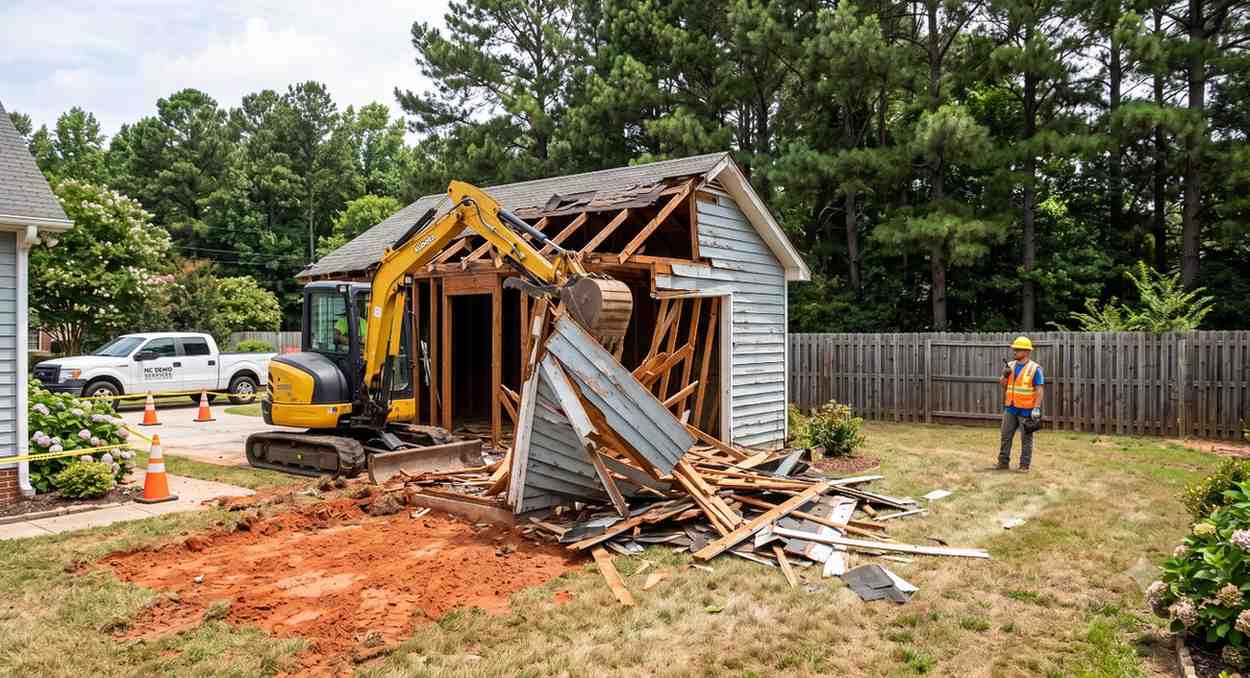
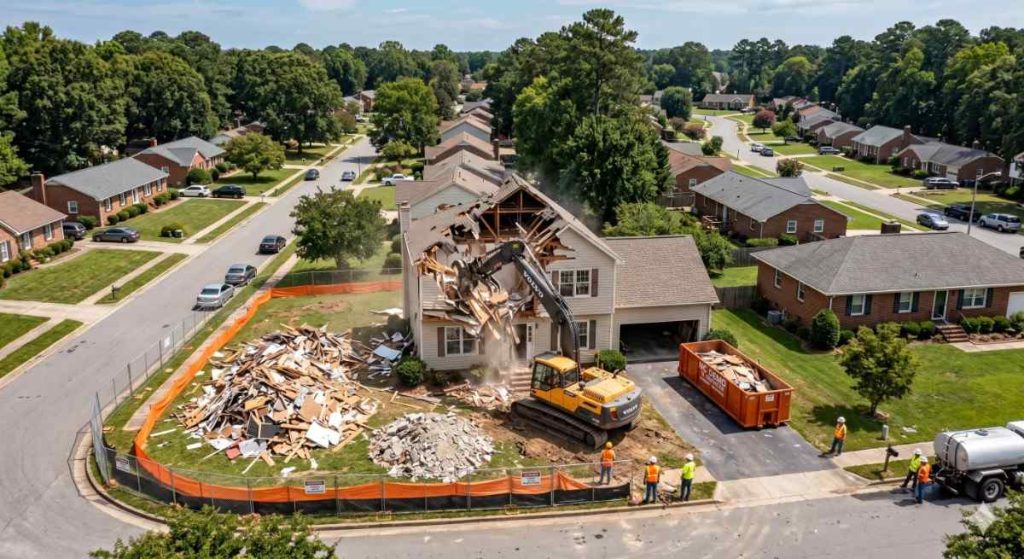
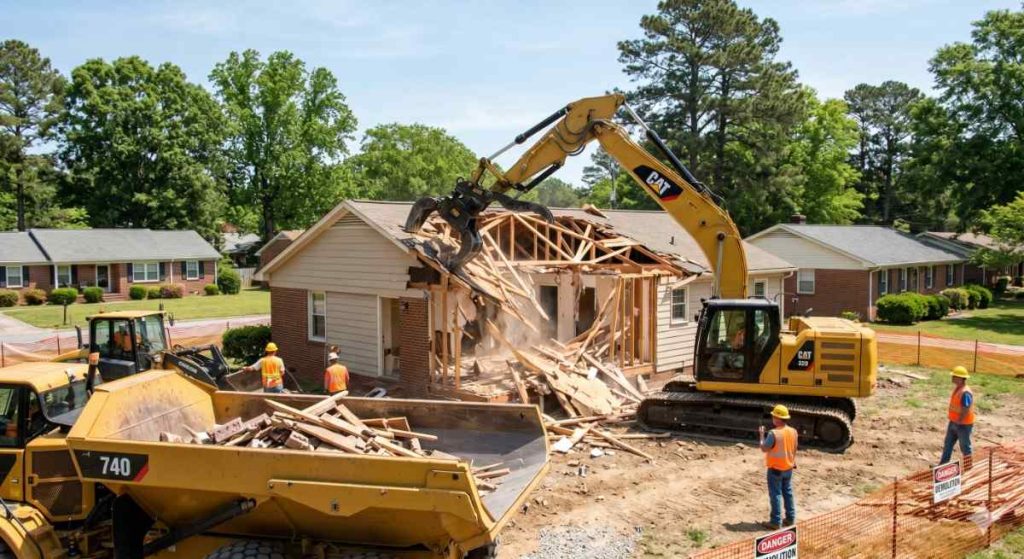
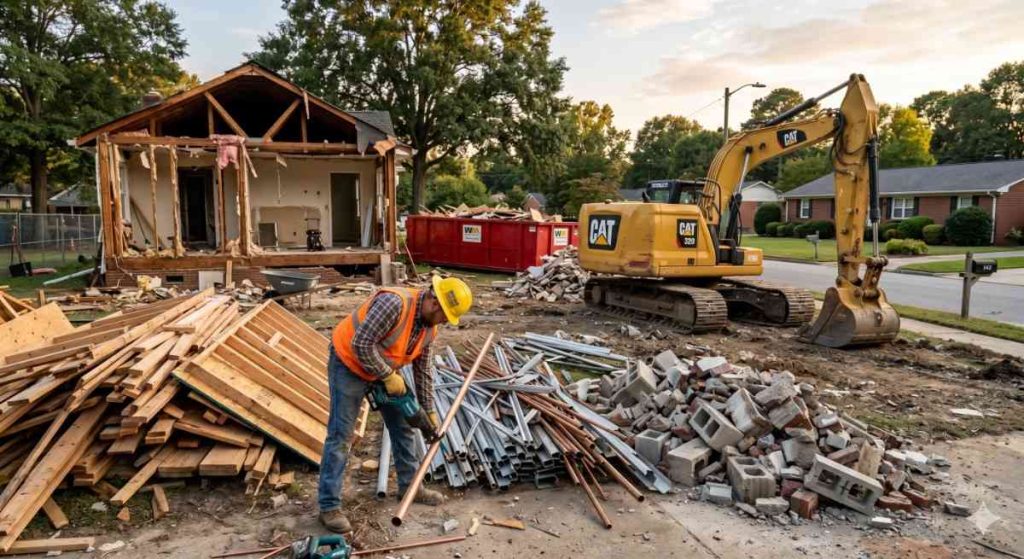
This is the most common approach for residential teardowns in North Carolina. An excavator — typically a 30,000 to 60,000-pound machine with a thumb or grapple attachment — systematically dismantles the structure from top to bottom. Roofing comes off first, then walls, framing, and finally the foundation. Materials are sorted on-site as they come down: wood to one pile, metal to another, concrete and masonry to a third.
Mechanical demolition is fast, efficient, and cost-effective for most residential structures. A typical single-story ranch home can be fully demolished and cleared in three to five days. Two-story homes and larger properties may take five to ten days.
Deconstruction (Selective Dismantling)
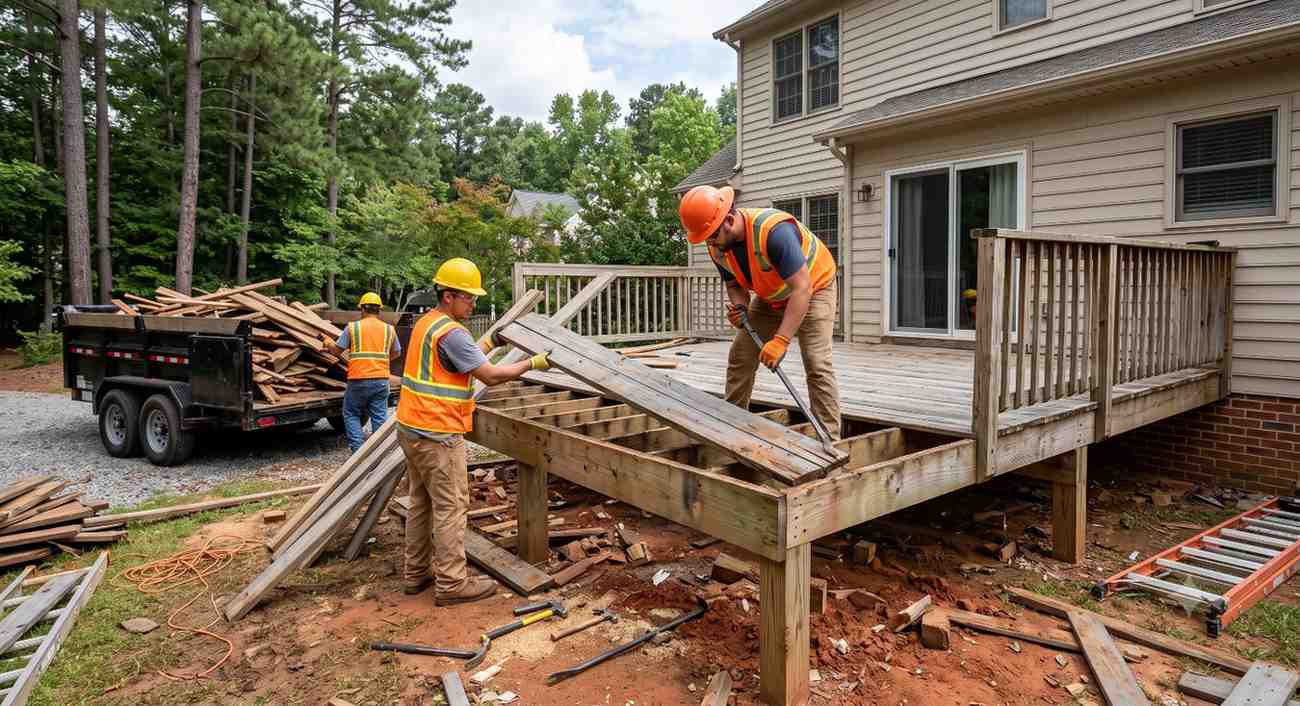
Deconstruction is the slower, more deliberate approach. Instead of tearing the house apart with heavy equipment, the crew hand-disassembles the structure piece by piece, salvaging reusable materials — hardwood flooring, doors, windows, fixtures, trim, brick, and dimensional lumber.
Deconstruction takes significantly longer (often two to four times as long as mechanical demolition) and costs more in labor. However, the salvaged materials can be donated to organizations like Habitat for Humanity ReStore for a tax deduction, which can partially offset the higher cost. Deconstruction also diverts substantially more material from landfills.
This method makes the most sense for older homes with high-quality materials worth salvaging — original hardwood floors, solid wood doors, historic brick, copper plumbing, or architectural details with resale value.
| Factor | Mechanical Demolition | Deconstruction |
|---|---|---|
| Speed | 3–10 days | 2–4 weeks |
| Cost | Lower | Higher (more labor) |
| Material recovery | Metals, concrete recycled | Extensive salvage of reusable items |
| Best for | Standard teardowns, time-sensitive projects | Historic homes, high-value salvage, tax deductions |
| Environmental impact | Moderate (recycling) | Lower (maximum reuse) |
Most residential demolitions in North Carolina use mechanical demolition, with selective salvage of high-value items (copper, fixtures, appliances) before the excavator starts.
What Drives the Cost of Home Demolition in North Carolina
Home demolition pricing depends on a handful of project-specific variables. No two houses are identical, which is why no responsible contractor quotes a flat price from a photo.
Home Size (Square Footage)
Square footage is the baseline for most estimates. A 1,200-square-foot ranch produces less debris, requires less equipment time, and generates fewer truckloads than a 3,500-square-foot two-story. More square footage means more of everything — labor, fuel, hauling, and disposal.
Construction Materials
Wood-frame homes are the easiest and least expensive to demolish. The framing comes apart quickly, and wood debris is lighter than masonry. Brick, stone, and concrete-block homes require heavier equipment and more time to break apart. Homes with concrete foundations, multiple chimneys, or stone veneers add additional scope and cost.
Hazardous Materials
Homes built before 1980 in North Carolina commonly contain asbestos (in floor tiles, insulation, pipe wrap, siding, and popcorn ceilings), lead-based paint, or both. Federal and state law require a certified inspection before demolition. If hazardous materials are confirmed, a licensed asbestos abatement contractor removes and disposes of them before general demolition begins. This adds cost and time but is non-negotiable — it protects the crew, neighbors, and environment.
The NC Department of Environmental Quality (NC DEQ) oversees asbestos regulations in the state. Demolition contractors are required to submit a notification to NC DEQ’s Health Hazards Control Unit at least 10 working days before demolishing any structure, regardless of whether asbestos is present.
Foundation Type and Removal
Once the house is down, the foundation still needs to be addressed. Crawl-space homes on concrete block piers are the simplest — the blocks come out easily. Slab-on-grade foundations require breaking and removing thick concrete. Full basements are the most complex and expensive, involving wall demolition, floor slab removal, and extensive backfill. Foundation removal is typically included in the project scope but significantly affects the total price.
Site Access and Location
Urban and suburban homes with tight lot lines, fences, overhead power lines, and neighboring structures require more careful equipment operation than a farmhouse on two acres. Limited access means smaller equipment, slower work, and more manual labor. Homes in HOA communities may also require advance notification and specific working-hour restrictions.
Hauling and Disposal Distance
The distance from your property to recycling facilities, landfills, and scrap yards affects trucking costs. Projects in metro Charlotte, Raleigh-Durham, and the Triad typically have shorter hauls and more disposal options. Rural properties may pay a premium for transport.
For an accurate cost based on your specific property, call (888) 643-4199 for a free on-site estimate.
Permits, Inspections, and Regulations
Home demolition in North Carolina is regulated. Skipping steps can result in fines, stop-work orders, and legal liability.
Demolition Permits
Nearly every NC municipality and county requires a demolition permit before you can tear down a residential structure. The application typically requires a site plan, a description of the structure, proof of ownership, and confirmation that utilities have been or will be disconnected. Some jurisdictions also require a copy of the asbestos inspection report. Permit fees vary — some counties charge a flat fee, others base it on project valuation.
Your demolition contractor should handle the entire permit process as part of the project scope.
Asbestos Notification (NC DEQ)
Regardless of whether asbestos is present, North Carolina law requires a written notification to NC DEQ’s Health Hazards Control Unit at least 10 working days before demolishing any commercial or residential structure. This notification, also known as a “NESHAP notification” (National Emission Standards for Hazardous Air Pollutants), is the contractor’s responsibility. Failing to file it can result in significant fines from both state and federal EPA enforcement.
Utility Disconnection
All utilities must be formally disconnected before demolition starts — electricity, natural gas, water, sewer, cable, and phone. This isn’t just turning off the breaker; it means having the utility company physically disconnect the service at the meter or junction. In some NC counties, a final meter reading and formal disconnect request must be submitted weeks in advance. If the property has a septic system or well, those may need separate decommissioning per county health department rules.
Inspections
Some jurisdictions require a pre-demolition inspection (especially if the home is in a historic district or a floodplain) and a post-demolition inspection to verify the site has been properly cleared and graded. Your contractor coordinates these with the local building department.
What to Expect on Demolition Day (and the Days Before and After)
Understanding the timeline removes the uncertainty from the project.
Week Before: Prep Work
The crew or a subcontractor disconnects utilities, performs any required hazardous material abatement, and removes items with salvage value (appliances, fixtures, copper, HVAC equipment). If a fence or landscaping needs to come down for equipment access, that happens now. The dumpster or roll-off containers are delivered and staged.
Day 1–2: Soft Strip and Interior Gutting
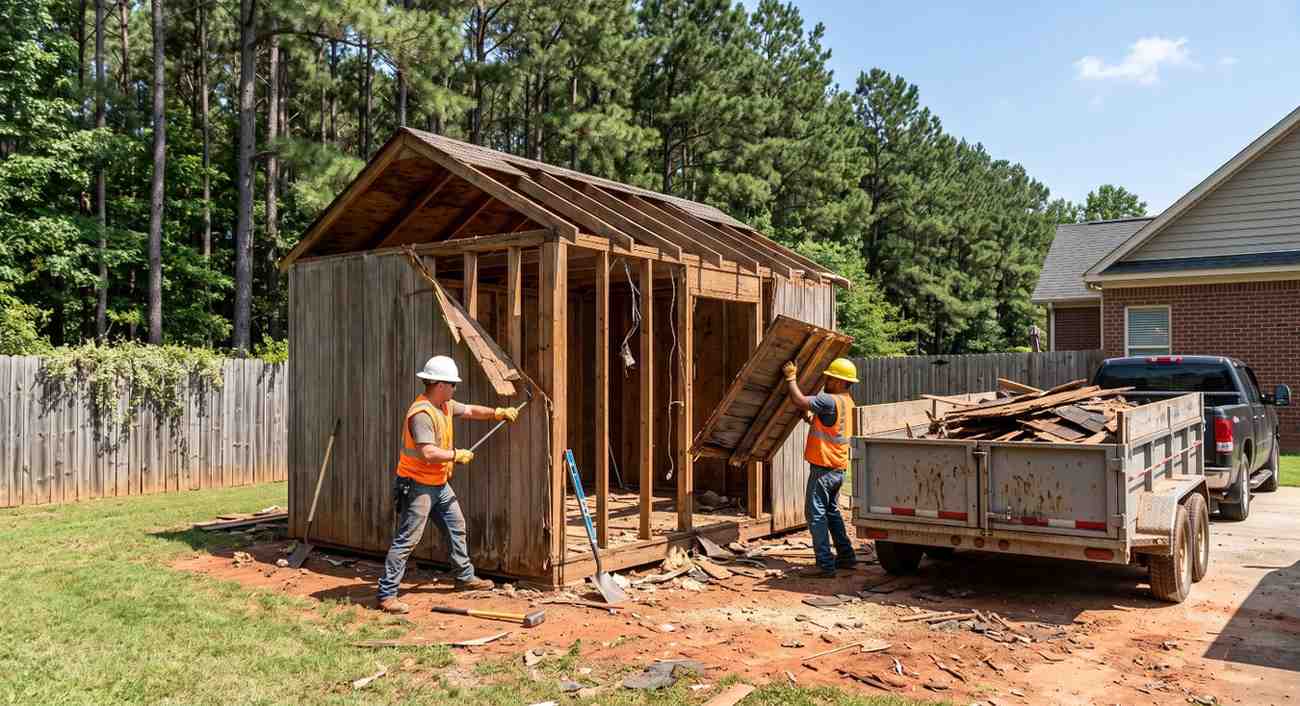
On smaller projects, this may be combined with the main demolition. On larger homes, the crew spends a day or two gutting the interior — pulling out cabinets, drywall, flooring, plumbing, and wiring. This makes the structural demolition cleaner and improves material sorting and recycling rates.
Days 2–5 (or longer): Structural Demolition
The excavator goes to work. Starting from the top, the operator pulls down the roof, then the walls, then the framing. The machine operator and ground crew sort materials as they fall — metal in one pile, wood in another, masonry and concrete to the side. Dump trucks rotate in to haul loads to recycling facilities and disposal sites. Dust suppression systems keep particulates under control.
Days 5–7: Foundation Removal and Backfill
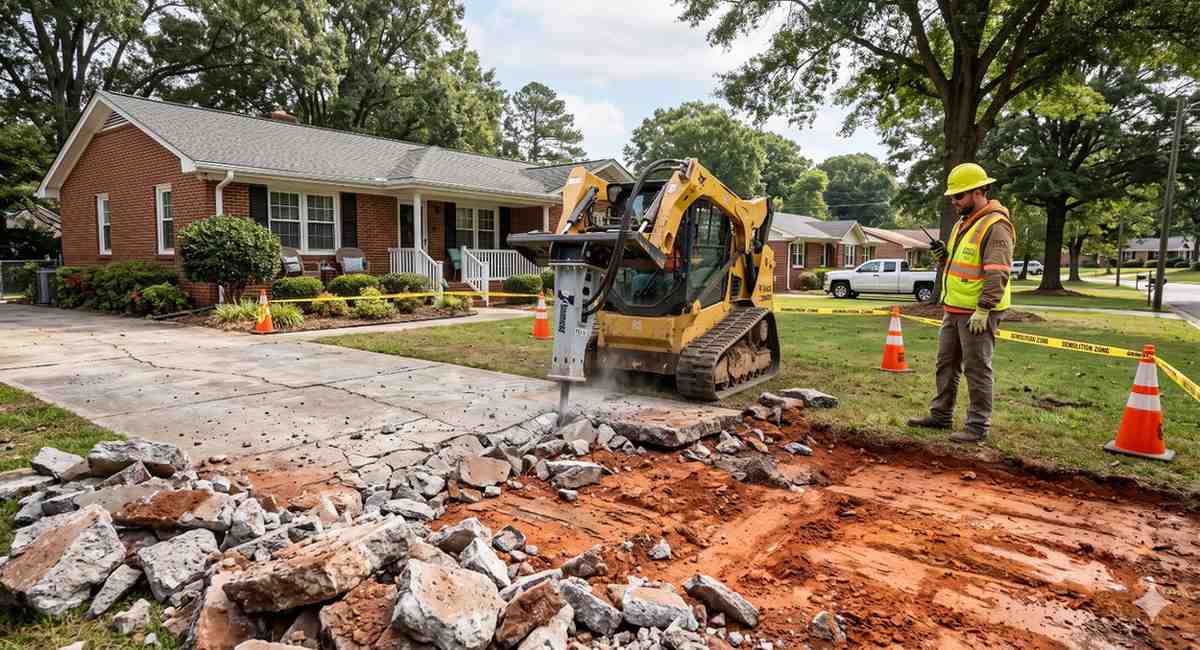
Once the structure is gone, the foundation comes out. For crawl-space homes, this is relatively quick. For homes with slabs or basements, it takes longer — the concrete is broken up with a hydraulic breaker, rebar is cut and separated for recycling, and the cavity is backfilled in compacted lifts with clean engineered fill.
Final Day: Grading and Cleanup
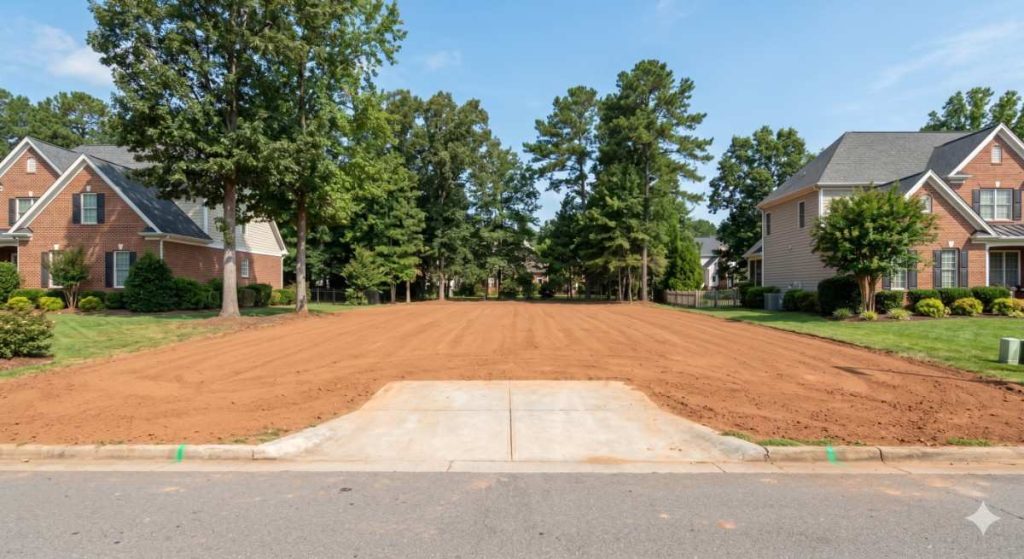
The site is graded smoothly and sloped for proper drainage. All debris is removed, the driveway and street are swept clean, and the lot is left ready for new construction, landscaping, or whatever comes next. Land grading services fine-tune the surface to match your plans.
Should You Demolish or Renovate
This is the question that brings most homeowners to a blog post like this one in the first place. There’s no universal answer, but there are clear signals in each direction.
Demolition makes more sense when:
The foundation has major structural problems (significant settling, cracking, and water intrusion) that would cost tens of thousands of dollars to repair. The home’s layout, systems, and structure are so outdated that a renovation would essentially mean rebuilding from the inside out anyway.
The cost of renovation exceeds 50-60 percent of what a new home on the same lot would cost. The home contains extensive hazardous materials (asbestos, lead, and mold), making renovation impractical. Or the home is simply beyond reasonable repair — fire damage, prolonged vacancy, severe neglect.
Renovation makes more sense when:
The foundation and framing are structurally sound. The home has historical, architectural, or sentimental value that warrants preservation. The renovation scope is targeted — a kitchen, bathroom, or addition — rather than a whole-house gut. Zoning restrictions would prevent you from building a home of the same size or style if you demolished the current one (common in some historic districts).
A good demolition contractor will be honest about whether demolition is the right call for your situation. If a renovation makes more sense, they’ll tell you. Carolina Demo & Removal provides free on-site assessments for home demolition projects across North Carolina — call (888) 643-4199 to schedule one.
What Happens to the Debris
A typical single-family home demolition in North Carolina produces 100 to 200 tons of debris, depending on the home’s size and construction. Here’s where it goes.
Metal (steel beams, copper wiring and plumbing, aluminum siding, iron pipe, HVAC components) goes to scrap metal recyclers. Metal has real market value, and separating it reduces the project’s overall disposal cost.
Concrete and masonry (foundation walls, slabs, block, brick) get processed through concrete crushing and recycling operations and turned into reusable aggregate for road base, drainage, and backfill.
Wood framing, sheathing, and trim are sent to wood recycling facilities when available, or to licensed disposal facilities. Clean, untreated dimensional lumber can sometimes be salvaged for reuse.
Roofing, insulation, drywall, flooring, and mixed debris go to licensed construction and demolition (C&D) landfills.
Hazardous materials (asbestos, lead paint, and chemical contamination) are transported to certified hazardous waste disposal facilities in accordance with NC DEQ and EPA regulations.
Carolina Demo & Removal’s debris cleanup and recycling teams sort and process materials on every job to maximize diversion from landfills.
Key Takeaways for Home Demolition in North Carolina
- Get a pre-demolition asbestos inspection before anything else. Homes built before 1980 commonly contain asbestos in multiple locations, and NC law requires a 10-day advance notification to NC DEQ before any demolition.
- Request on-site estimates from at least two to three contractors. Home demolition costs depend on square footage, construction materials, foundation type, hazardous materials, site access, and hauling distance — no accurate quote can be given over the phone alone.
- Confirm that your contractor handles permits, utility disconnection, and inspections as part of the scope. You shouldn’t be chasing paperwork.
- Ask about the demolition method. Mechanical demolition is standard for most homes. Deconstruction costs more but salvages reusable materials and may provide a tax deduction for donated items.
- Plan for foundation removal. A demolished house leaves behind a foundation that still needs to come out — don’t assume it’s included unless the estimate explicitly says so.
- Consider timing. Demolition projects in North Carolina run year-round, but spring and summer are the busiest seasons. Scheduling flexibility in late fall or winter can sometimes mean shorter lead times.
- Think beyond the demolition. What are you doing with the lot next? New construction, landscaping, and land sales each require different levels of site preparation and grading.
Frequently Asked Questions
Q: How much does it cost to demolish a house in North Carolina?
A: Residential demolition in NC typically runs between $5 and $15 per square foot, depending on the home’s size, construction materials, foundation type, and whether hazardous materials are present. A 1,500-square-foot ranch costs significantly less than a 3,000-square-foot two-story brick home. Get an on-site estimate for an accurate number.
Q: How long does a home demolition take?
A: Most single-family home demolitions take three to ten days from the start of demolition to final grading. Add additional time for pre-demolition hazardous material abatement if needed, and account for permit processing before the crew can start.
Q: Do I need a permit to demolish a house in NC?
A: Yes. Nearly every NC municipality and county requires a demolition permit. Your contractor handles the application, but you should also be aware of the mandatory 10-day asbestos notification to NC DEQ, which applies to all demolitions regardless of asbestos presence.
Q: What happens to the foundation after the house is demolished?
A: The foundation is typically removed as part of the project. Crawl-space foundations on concrete block piers are straightforward. Slab-on-grade and full basements require concrete breaking, rebar cutting, and backfill, which adds cost and time.
Q: How do I know if my house has asbestos?
A: Any home built before 1980 should be inspected by a certified asbestos inspector before demolition. Common locations include floor tiles (9×9-inch tiles are a strong indicator), pipe insulation, popcorn ceilings, cement siding, and HVAC duct wrap. The inspection is typically arranged by your demolition contractor.
Q: Can I live in my house during demolition?
A: No. The home must be fully vacated before demolition begins. Utilities are disconnected, and the structure becomes an active demolition site with heavy equipment, falling debris, and dust — it’s not habitable at any point during the process.
Get a Free Estimate for Home Demolition in North Carolina
Whether you’re clearing an aging structure for new construction, removing a fire-damaged home, or tearing down a property past the point of renovation, home demolition goes more smoothly with a contractor who handles every step — permits, inspections, hazmat abatement, demolition, debris hauling, and site grading. Carolina Demo & Removal has been handling home demolition and residential demolition projects across North Carolina since 2010. Call (888) 643-4199 for a free on-site estimate, or request a quote online.