Sooner or later, concrete wears out. That driveway you poured fifteen years ago is now a spider web of cracks. The old patio slab behind the house has heaved and settled, causing it to slope toward the foundation rather than away from it. Or maybe you bought a property with a crumbling set of front steps and a detached garage pad that needs to go before you can start building.
Concrete removal is one of the most common residential demolition projects in North Carolina, yet it’s also among the most misunderstood. Homeowners tend to underestimate how heavy, reinforced, and stubborn old concrete can be — and overestimate how easy it is to break up with a rented jackhammer.
This guide covers the types of concrete you might need removed, the equipment and methods professionals use, what drives the cost, and how to decide whether your project is a weekend DIY job or one that needs a crew with an excavator.
Types of Concrete You Might Need Removed
Not all concrete removal is the same job. A 3-inch unreinforced patio slab is a fundamentally different project from an 8-inch rebar-reinforced foundation wall. Here’s a breakdown of the most common residential concrete removal projects in North Carolina and what makes each one unique.
Driveways
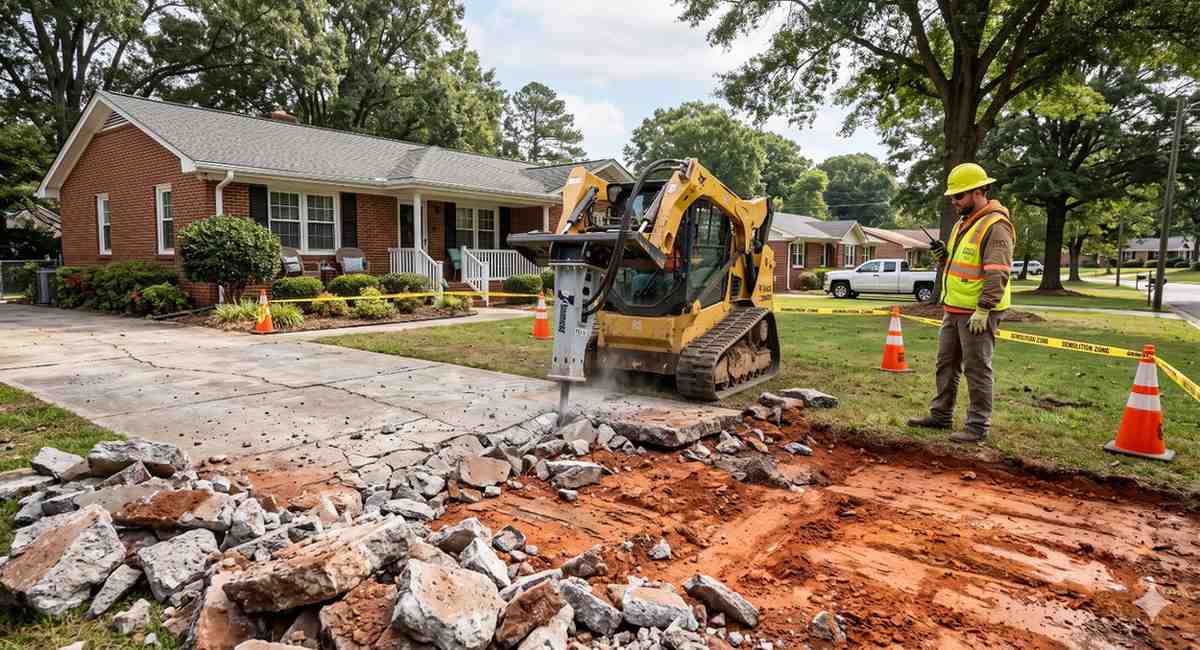
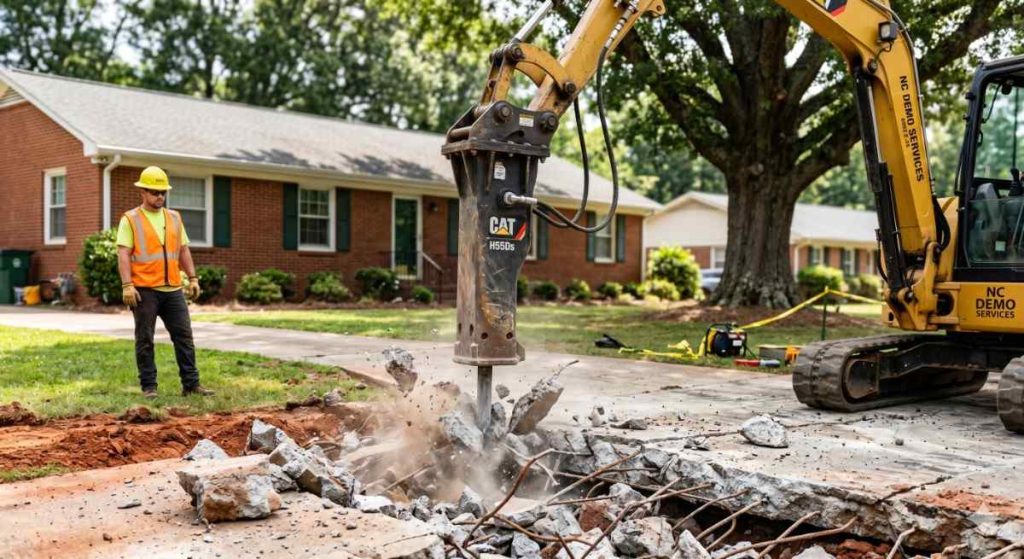
Residential driveways in North Carolina are typically 4 to 6 inches thick, often reinforced with wire mesh or light rebar. A standard two-car driveway can produce 15 to 20 tons of concrete debris — that’s multiple truckloads. Driveway removal usually requires an excavator with a hydraulic breaker to crack the slab, plus a loader to pick up and haul chunks.
Access is rarely a problem, since the driveway itself serves as the access point. If your driveway connects to a public sidewalk or road, check with your municipality about right-of-way requirements before starting work. Learn more about driveway removal in North Carolina.
Slabs (Patios, Garage Pads, Shed Pads)
Concrete slabs vary widely in thickness, reinforcement, and condition. A backyard patio might be 3 to 4 inches of plain concrete sitting on compacted gravel — relatively straightforward to break up and remove. A garage pad, on the other hand, could be 5 to 6 inches thick with rebar grid and a turned-down edge footing that goes a foot or more into the ground.
The deeper and more reinforced the slab, the more equipment and labor the job requires. Carolina Demo & Removal handles concrete slab removal projects of all sizes across North Carolina.
Steps and Stoops
Front steps, back stoops, and porch landings are small in footprint but dense. They’re typically solid concrete — no voids, no hollow blocks — which makes them surprisingly heavy for their size. A set of four or five front steps can weigh well over a ton. Removing them usually involves a combination of jackhammer work to break the mass into manageable pieces and careful cutting near the house foundation to avoid damaging the structure. Details on concrete steps removal.
Foundations and Footings
Foundation walls, strip footings, and pier bases are the heaviest residential concrete removal work. They’re built to carry the weight of a house, which means thick walls (8 to 12 inches), heavy rebar, and sometimes anchor bolts embedded in the top. Removing a foundation is a multi-day project that usually follows a home demolition. The crew needs to excavate around the walls to access them, break them apart, cut the rebar, and haul everything out before backfilling the hole. Foundation removal is not a DIY project under any circumstances.
Retaining Walls and Sidewalks
Retaining walls introduce a complication that flat concrete doesn’t: once you remove the wall, the soil it was holding back needs to go somewhere. Poor planning can lead to erosion, grading problems, or drainage issues on your property or your neighbor’s. Sidewalks are simpler — usually 4 inches thick and unreinforced — but long runs still produce a lot of debris that needs to be loaded and hauled.
Equipment and Methods Used in Concrete Removal
The right tool for the job depends entirely on what you’re removing. Here’s what professionals bring to a concrete removal project and when each tool gets used.
Excavator with Hydraulic Breaker
This is the workhorse for most medium and large-sized residential concrete removal jobs. The hydraulic breaker (sometimes called a hoe ram) mounts on the arm of a compact or mid-size excavator and delivers repeated high-energy strikes that fracture concrete efficiently. It’s the go-to for driveways, thick slabs, and foundation walls. The same excavator then uses a bucket or thumb attachment to pick up the broken chunks and load them into a truck or container.
Jackhammers (Pneumatic and Electric)
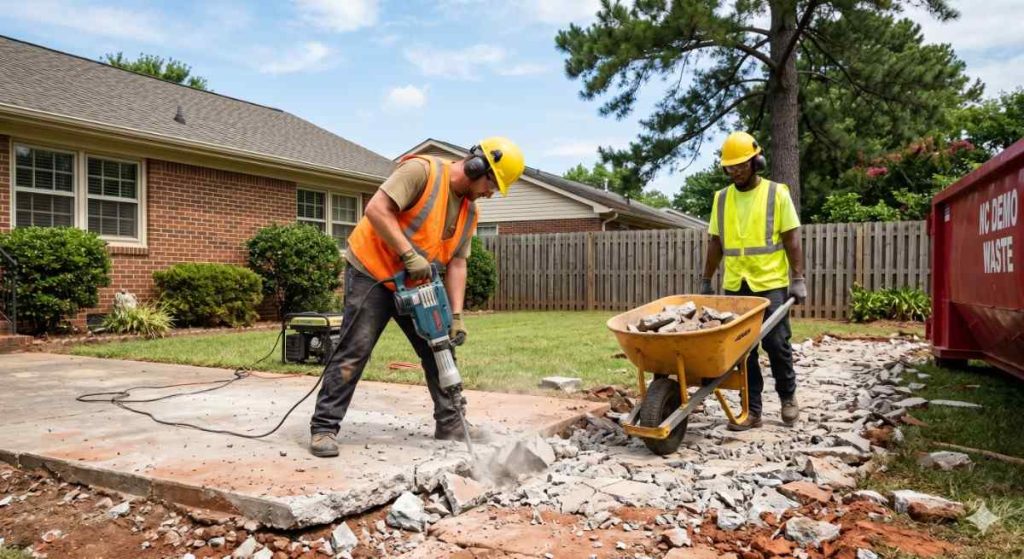
For smaller areas — steps, thin sidewalks, small patio sections — a handheld jackhammer is often enough. Electric jackhammers are common on residential jobs because they don’t require a separate air compressor. They’re slower than an excavator-mounted breaker but more precise, which matters when you’re working close to a house foundation or a structure you want to keep.
Concrete Saws
When a project calls for clean, straight cuts — like removing a section of driveway while leaving the rest intact, or cutting an expansion joint before breaking — concrete saws are essential. Walk-behind saws handle flat surfaces; handheld cut-off saws work for steps, curbs, and vertical cuts. Sawing creates a controlled break line that prevents cracks from running into the concrete you want to preserve.
Skid Steers and Loaders
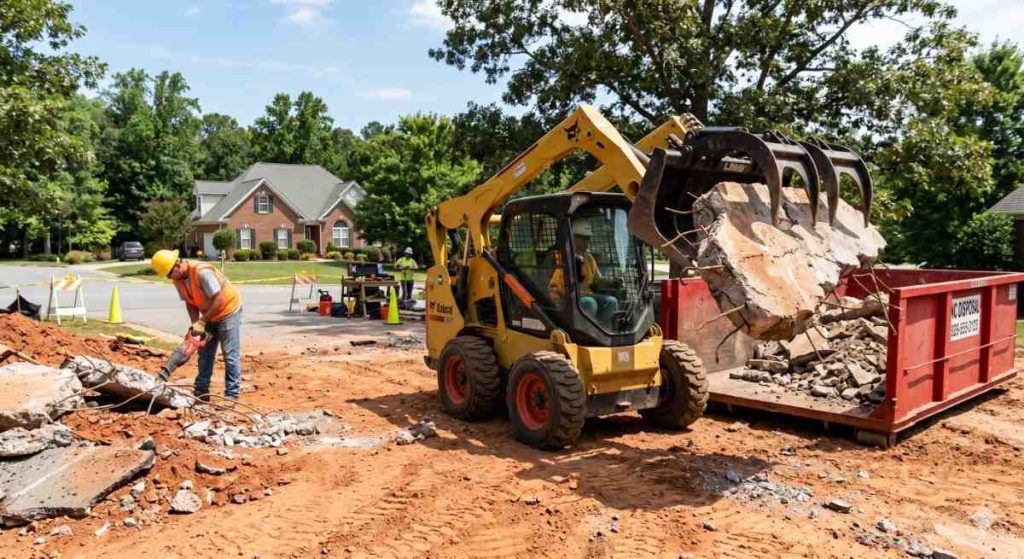
Once the concrete is broken, it needs to be moved. Skid steers with bucket or grapple attachments handle cleanup and loading on most residential sites. They’re compact enough to maneuver through side yards and gates, and powerful enough to pick up large chunks of reinforced concrete.
Rebar Cutting Tools
Any reinforced concrete removal project involves rebar. Once the concrete is broken away, the exposed rebar needs to be cut with torches, reciprocating saws, or hydraulic shears so it can be separated and sent to a metal recycler. Leaving rebar protruding from broken concrete is a safety hazard and makes debris harder to haul.
What Drives the Cost of Concrete Removal
Concrete removal pricing in North Carolina depends on several project-specific variables. No two jobs are the same, which is why a flat per-square-foot rate rarely tells the whole story.
Thickness and Reinforcement
A 3-inch unreinforced patio slab breaks up quickly with minimal equipment. A 6-inch rebar-reinforced driveway takes two to three times as long with heavier equipment. Thickness and reinforcement are the single biggest cost drivers because they directly affect labor hours, equipment wear, and debris volume.
Total Area
More square footage means more breaking, more loading, more trucking. Removing a 200-square-foot patio is a half-day job. A 1,200-square-foot driveway is a full day or more.
Site Access
Wide-open front driveways with easy street access keep costs down. Backyard patios accessible only through a narrow gate or over landscaping require smaller equipment, more hand labor, or the temporary removal of a fence — all of which add cost and time.
Disposal Method
Hauling concrete to a landfill is the most expensive disposal route. Recycling is often cheaper and always more sustainable. Concrete crushing and recycling turn demolished concrete into reusable aggregate for road base, drainage backfill, and new construction projects. According to the EPA, concrete is one of the most recyclable construction materials — keeping it out of landfills reduces both environmental impact and project costs.
Proximity to Structures
Concrete removal next to a house foundation, utility lines, or a structure you want to keep requires more precision. The crew may need to use saws and jackhammers instead of an excavator breaker, work in smaller increments, and take extra precautions to prevent vibration damage. Precision work costs more than open-field demolition.
Hauling Distance
The distance from your property to the disposal or recycling facility affects trucking costs. Urban projects in Charlotte, Raleigh, or the Triangle usually have shorter hauls. Rural properties in the mountains or on the coastal plain may cost more to transport.
Every project is different, so the most accurate way to know your cost is to get an on-site estimate. Carolina Demo & Removal provides free estimates across North Carolina — call (888) 643-4199 to set one up.
Can You DIY Concrete Removal, or Should You Hire a Pro
Some concrete removal projects are genuinely doable for a handy homeowner. Others will ruin your weekend, your back, and possibly your property. Here’s a realistic breakdown.
DIY Is Reasonable When:
The concrete is thin (3 to 4 inches), unreinforced, and covers a small area — say, a cracked sidewalk section or a small shed pad under 100 square feet. You can rent an electric jackhammer for a day, break up the concrete into manageable pieces, and haul it away in a rented trailer or roll-off dumpster.
Budget a full day of hard physical labor, and make sure you have somewhere to take the debris — not all landfills accept concrete, and many charge by weight.
Hire a Pro When:
The concrete is reinforced with rebar or wire mesh, thicker than 4 inches, covers a large area (driveways, full patios, foundations), or sits close to structures you need to protect. Rebar turns a simple breakup job into a cut-and-separate operation that requires specialized tools.
Thick, reinforced slabs are physically dangerous to jackhammer by hand — the jackhammer bounces and kicks, and the concrete doesn’t break cleanly. An excavator-mounted breaker does in an hour what a rented jackhammer does in a day, with far less risk of injury or property damage.
Also, hire a pro if you don’t have a plan for the debris. A 20×40-foot driveway produces roughly 15 to 20 tons of concrete. That’s not going in the back of a pickup truck — it takes multiple dump truck loads or a large roll-off container. Professional demolition contractors have the trucks, relationships with recyclers, and disposal logistics already set up.
What Happens to the Concrete After Removal
One of the most common questions homeowners ask is where all that broken concrete actually goes.
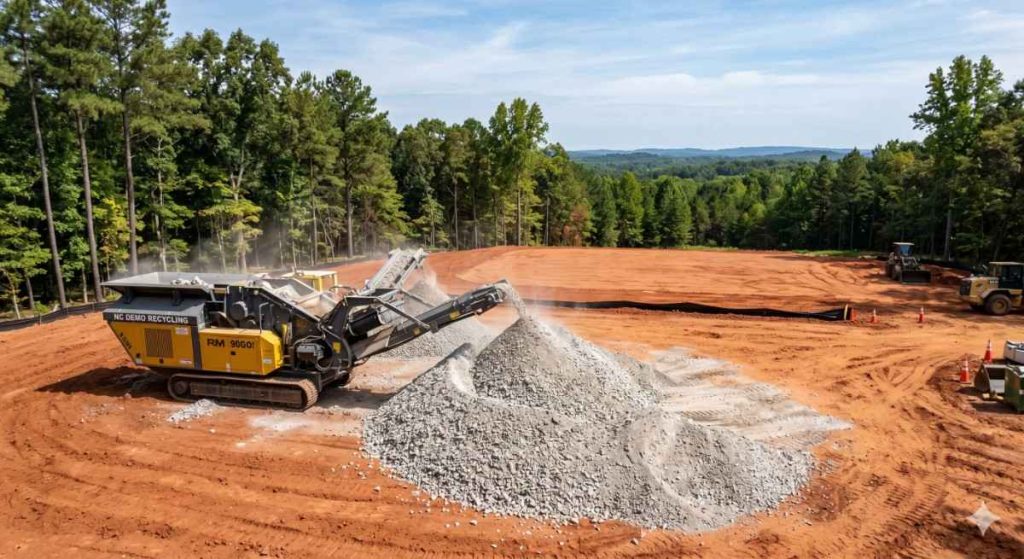
The best option — both environmentally and often financially — is recycling. Demolished concrete is fed into a crusher, where it is crushed into graded aggregate. This recycled material can be used as road base, pipe bedding, drainage stone, or backfill. It’s cheaper than virgin aggregate and keeps thousands of tons of material out of North Carolina landfills every year.
Metal reinforcement (rebar, wire mesh) is separated during crushing and sent to scrap metal recyclers. Even the fine concrete dust produced during crushing has uses in soil stabilization and as fill material.
Carolina Demo & Removal prioritizes recycling on every concrete removal project. Our concrete crushing and recycling services process demolished material into reusable aggregate, and our debris cleanup crews ensure your site is left spotless once the work is done.
When recycling isn’t possible — for example, if the concrete is contaminated with paint, sealers, or hazardous materials — it goes to a licensed disposal facility. Your contractor should be transparent about where your debris ends up.
Key Takeaways for Your Concrete Removal Project
- Know what you’re dealing with before you get quotes — measure the area, check the thickness if possible, and note whether you can see rebar or wire mesh in any cracks or edges.
- Driveways, foundations, and any slab thicker than 4 inches with rebar reinforcement are professional-grade jobs. Don’t underestimate the weight and difficulty of reinforced concrete.
- Ask contractors about their disposal and recycling practices. Recycling concrete is cheaper than landfilling it and keeps reusable material in circulation.
- Site access matters more than you’d think. If the equipment can’t easily reach the concrete, expect the project to take longer and cost more.
- Get two to three on-site estimates. Concrete removal costs vary based on thickness, reinforcement, area, access, and hauling distance — you need eyes on the job for an accurate price.
- If your concrete removal is part of a larger project (new driveway, home teardown, site preparation), bundle the work to save on equipment mobilization.
- Check whether your municipality requires a permit for concrete demolition — requirements vary across North Carolina counties and cities.
- Plan for what comes after the concrete is gone. You may need land grading or compaction work before you can pour new concrete, plant grass, or start construction.
Frequently Asked Questions
Q: How long does concrete removal take?
A: It depends on the scope. A small patio or set of steps can be done in half a day. A full driveway typically takes one to two days. Foundation removal following a house demolition may take three to five days. Your contractor should provide a timeline during the estimate.
Q: Do I need a permit to remove concrete in North Carolina?
A: It varies by municipality. Many NC cities and counties require a demolition permit for significant concrete removal work, especially if it involves a driveway connected to a public right-of-way or a foundation. Your contractor can check local requirements and pull permits on your behalf.
Q: Can old concrete be recycled instead of going to a landfill?
A: Yes — and it should be whenever possible. Concrete is one of the most recyclable construction materials. Crushed concrete aggregate is used for road base, drainage, and backfill. According to the EPA, recycling construction and demolition materials significantly reduces landfill demand.
Q: What’s the difference between a jackhammer and a hydraulic breaker?
A: A jackhammer is a handheld pneumatic or electric tool suited for small, precise work, steps, thin sidewalks, and patching areas. A hydraulic breaker is a much larger, excavator-mounted attachment that delivers far more force per strike. It’s used for driveways, thick slabs, and foundations where speed and power matter more than precision.
Q: Will concrete removal damage my lawn or landscaping?
A: Some disruption is unavoidable, especially along the edges of the concrete being removed. Equipment needs a path in and out, and heavy chunks of concrete can gouge soft ground. A professional crew minimizes the damage, protects what they can, and grades the disturbed areas when the job is done.
Q: How do I know if my concrete has rebar in it?
A: Look at any cracks, edges, or broken corners — if you see metal grid or bars, it’s reinforced. Older driveways (pre-1980s) sometimes used wire mesh instead of rebar, which is thinner but still complicates removal. If you’re not sure, your contractor will identify the reinforcement type during the site assessment.
Get a Free Estimate for Concrete Removal in North Carolina
Whether you’re tearing out a cracked driveway, removing an old patio slab, or clearing a foundation for new construction, concrete removal goes more smoothly with the right crew and equipment. Carolina Demo & Removal has been handling concrete demolition, concrete slab removal, and recycling projects across North Carolina since 2010. Call (888) 643-4199 for a free on-site estimate, or request a quote online. We’ll assess your project, explain your options, and give you a straightforward price.