Driveway removal in North Carolina involves breaking up and hauling away old concrete or asphalt to make way for a new surface, landscaping, or other improvements. Cost depends primarily on the driveway’s size, material, thickness, and reinforcement. Most residential driveway removals take one to two days, and a demolition permit may be required if the driveway connects to a public right-of-way.
That driveway has been cracking a little more every year. The tree roots pushed one slab up two inches, the expansion joints are full of weeds, and patching it one more time won’t change the fact that it needs to go.
Driveway removal is one of the most common concrete demolition projects across North Carolina. Whether you’re replacing a worn-out surface, converting to a permeable driveway, or clearing the way for a completely new layout, the old driveway has to come out first.
This guide covers the differences between concrete and asphalt removal, the equipment involved, the factors that drive cost, what happens to the subgrade underneath, and how to prepare your property before the crew arrives.
Concrete Driveways vs. Asphalt Driveways: Different Removal Jobs
The two most common driveway materials in North Carolina are concrete and asphalt. They come out differently, require different equipment approaches, and produce different types of debris.
Concrete Driveway Removal
Most residential concrete driveways in North Carolina are 4 to 6 inches thick, poured over a compacted gravel base. Older driveways and those designed for heavier loads may be reinforced with wire mesh or rebar.
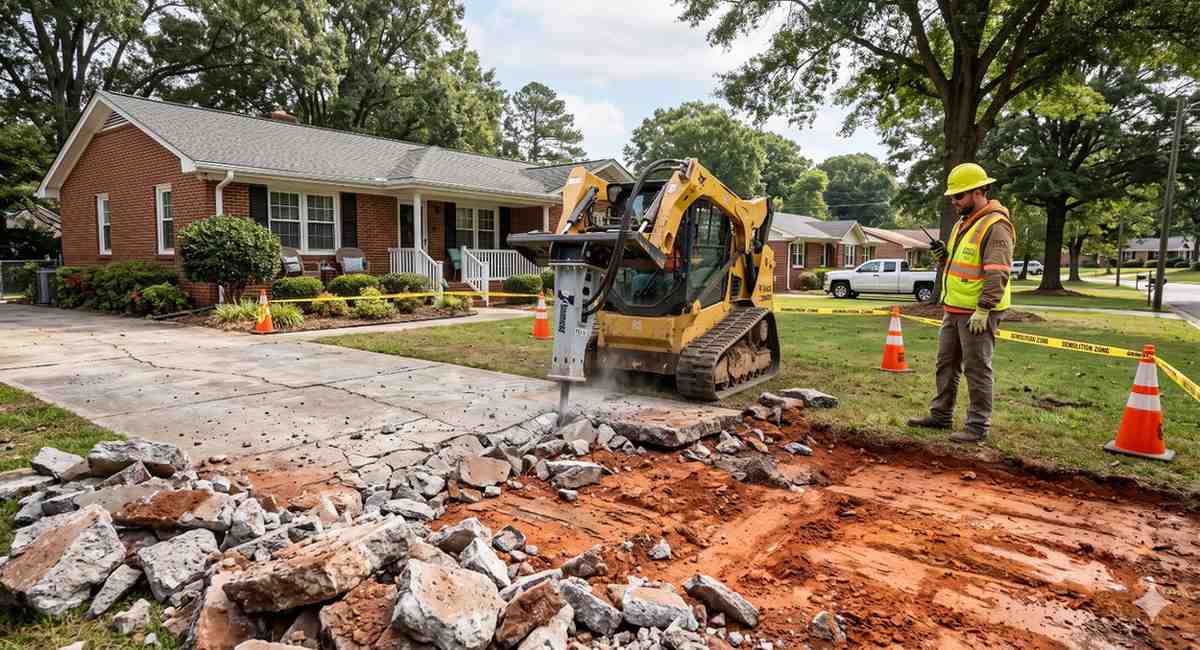
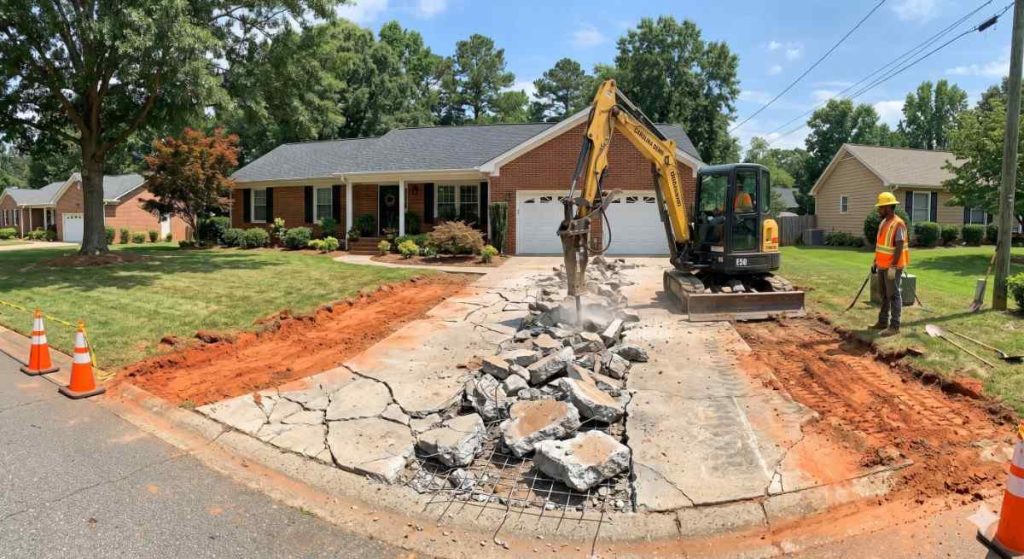
Removing a concrete driveway requires breaking the slab into pieces with a hydraulic breaker (mounted on an excavator) or a walk-behind concrete saw for controlled cuts along edges and expansion joints. The broken sections are then loaded with a skid steer or excavator bucket and hauled to a recycling facility or disposal site.
Reinforced concrete takes longer to remove because the wire mesh or rebar holds the broken pieces together. The crew has to cut the reinforcement as they go, which adds labor time.
Concrete debris is heavy — a standard two-car driveway (roughly 400 to 600 square feet at 5 inches thick) produces approximately 10 to 15 tons of material. That’s multiple dump truck loads.
Asphalt Driveway Removal
Asphalt driveways are typically 2 to 3 inches thick, laid over a gravel base. They’re softer and lighter than concrete, which makes removal faster and less equipment-intensive.
A skid steer with a cold-planing attachment or a standard bucket can rip up asphalt in large sheets. For smaller driveways, a crew with pry bars and a jackhammer can break it into pieces manually.
Asphalt is almost always recyclable. Old asphalt gets processed at a hot-mix plant and reused in new paving — it’s one of the most recycled materials in the construction industry.
The tradeoff is that asphalt removal can be messier. On hot days, asphalt softens and sticks to equipment and truck beds. Scheduling removal for cooler weather or early morning makes the job cleaner.
| Factor | Concrete | Asphalt |
|---|---|---|
| Typical thickness | 4–6 inches | 2–3 inches |
| Reinforcement | Often (wire mesh or rebar) | Rarely |
| Weight per sq ft | ~50-60 lbs (at 5″) | ~25-30 lbs (at 3″) |
| Removal difficulty | Higher (heavier, reinforced) | Lower (softer, lighter) |
| Recyclability | Yes (crushed into aggregate) | Yes (reprocessed at hot-mix plant) |
| Removal timeline | 1–2 days | Half day to 1 day |
Equipment Used for Driveway Removal
The equipment a contractor brings depends on the driveway’s material, size, and site access.
Excavator with Hydraulic Breaker
This is the primary tool for concrete driveways over 4 inches thick. The hydraulic breaker mounts on the excavator arm and delivers rapid, high-energy strikes that fracture concrete efficiently.
The same excavator switches to a bucket or grapple to pick up broken pieces and load them into trucks. One machine handles both breaking and loading, which keeps the job moving.
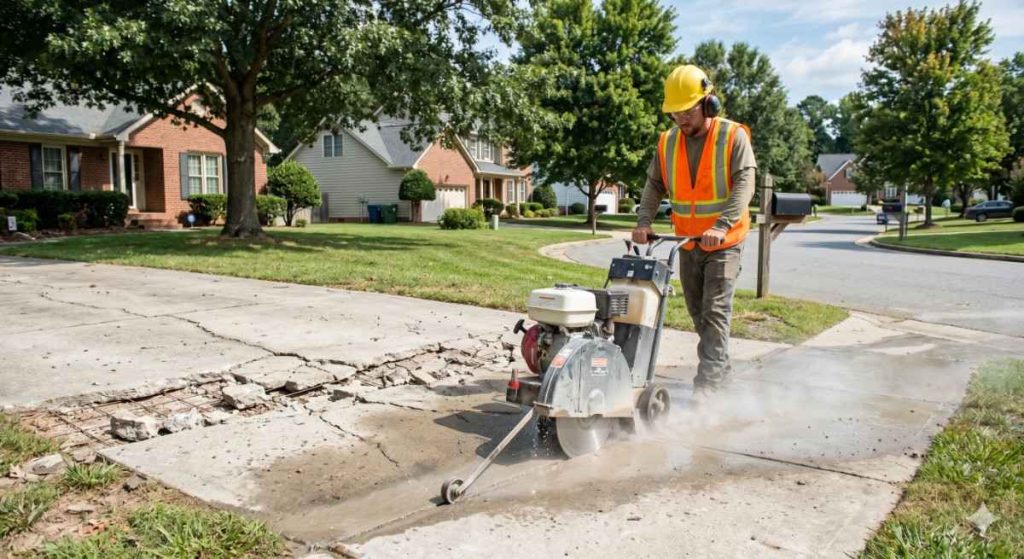
Walk-Behind Concrete Saw
When the driveway connects to a sidewalk, garage apron, or front porch that you want to keep, a concrete saw cuts a clean line where the removal stops. Without that cut, cracks can run into the concrete you’re keeping.
Saws are also used to cut along the public sidewalk or curb if the driveway meets a municipal right-of-way. This creates a clean separation and a neat edge for the new surface.
Skid Steer
Skid steers handle cleanup, loading, and grading after the concrete is broken. They’re compact enough to work in residential driveways without tearing up the lawn on either side.
For asphalt driveways, a skid steer with a bucket attachment can often handle the entire removal — ripping, loading, and grading in one pass.
Jackhammers
Handheld jackhammers are used for detail work — breaking concrete near a garage floor, around a drain, or where the driveway meets the front walkway. They’re slower than an excavator-mounted breaker but more precise.
On small driveways (single-car, short runs), a jackhammer may be the primary tool for the entire job.
What Drives the Cost of Driveway Removal
Driveway removal pricing in North Carolina varies based on several project-specific factors. Here’s what moves the number up or down.
Driveway Size
Square footage is the baseline. A short single-car driveway (150 to 200 square feet) is a half-day job. A long two-car driveway with a turnaround (600+ square feet) takes a full day or more and produces far more debris.
Material and Thickness
Asphalt is cheaper to remove than concrete because it’s thinner, lighter, and doesn’t have reinforcement. A 6-inch reinforced concrete driveway costs considerably more to break up and haul than a 3-inch asphalt surface.
Reinforcement
Wire mesh and rebar add significant labor time. The crew has to cut reinforcement between every section of broken concrete, which slows down the breaking, loading, and hauling cycle.
Unreinforced concrete breaks cleanly and loads fast. Reinforced concrete fights back at every step.
Right-of-Way Complications
If your driveway connects to a public street, sidewalk, or curb, some North Carolina municipalities require a right-of-way permit or encroachment agreement before you can demolish or alter the driveway apron. This is the section of driveway between the sidewalk and the street.
Check with your local public works department before starting. Your contractor can usually advise on whether a permit is needed in your area.
Disposal and Recycling
Concrete can be recycled into crushed aggregate for road base, drainage, and backfill through concrete crushing and recycling. Asphalt gets reprocessed at hot-mix plants.
Recycling is often cheaper than landfilling and keeps material out of C&D disposal facilities. The number of truckloads and the distance to the recycling facility or landfill directly affect hauling costs.
Subgrade Condition
If the gravel base underneath the driveway is in good shape, it can be reused for the new surface. If the subgrade has eroded, settled, or been contaminated with clay, it needs to be removed and replaced — adding material costs and labor.
Call (888) 643-4199 for a free on-site estimate on your driveway removal project in North Carolina.
What Happens After the Driveway Is Removed
Tearing out the old driveway is step one. What happens to the ground underneath determines how well your new surface performs.
Subgrade Inspection
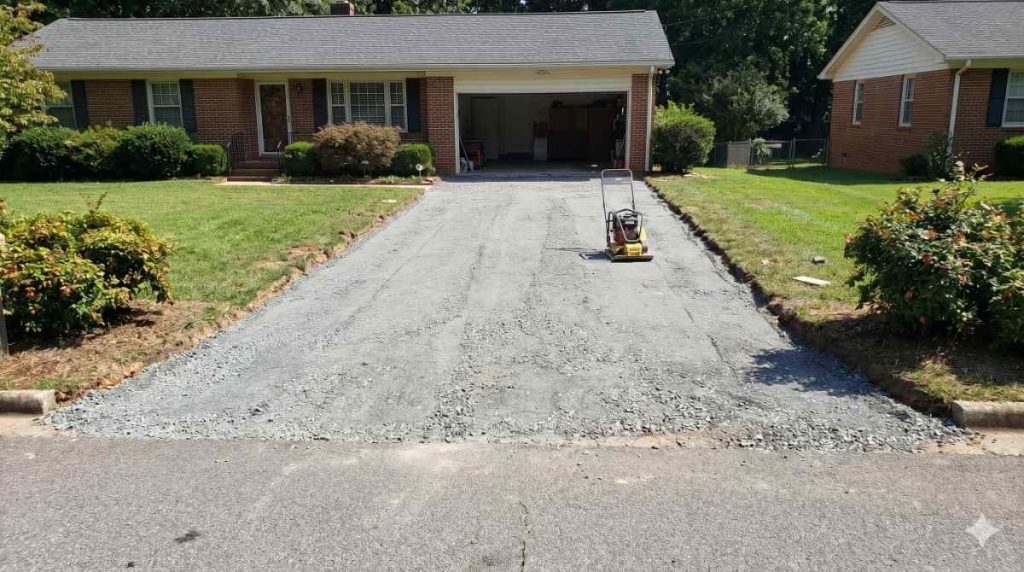
Once the concrete or asphalt is gone, the crew inspects the exposed gravel base. A solid, well-compacted subgrade that hasn’t shifted or eroded can be reused as the foundation for a new driveway.
If the subgrade has soft spots, clay intrusion, root damage, or poor compaction, those areas need to be excavated and replaced with clean, compacted aggregate.
Grading and Compaction
The subgrade is graded to ensure proper slope away from the house and garage. Water should flow down the driveway toward the street — not pool against the foundation.
Compaction is done in lifts using a vibratory plate compactor or roller. Proper compaction prevents settling and cracking in whatever surface you pour or lay on top.
Common Next Steps
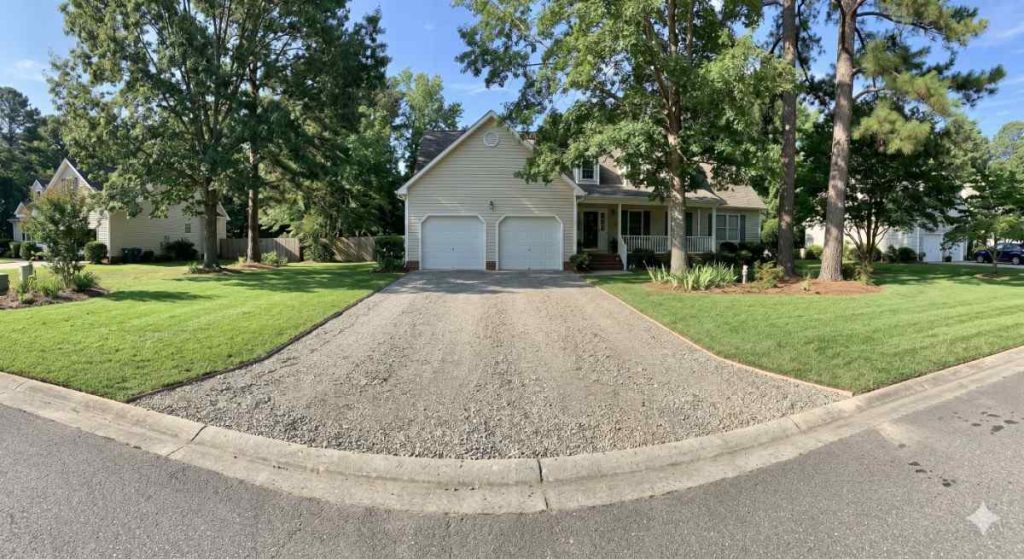
Most homeowners who remove a driveway are planning one of the following: pouring a new concrete driveway, laying new asphalt, installing pavers or permeable paving, converting the space to landscaping or garden, or widening the driveway footprint before repaving.
If you’re not installing a new surface right away, land grading ensures the exposed subgrade drains properly and doesn’t create erosion problems while it sits exposed.
How to Prepare Before the Crew Arrives
A little preparation on your end makes the project go faster and protects your property.
Clear the Driveway
Move all vehicles, bikes, trash cans, basketball hoops, and anything else sitting on or near the driveway. The crew needs full, unobstructed access from the street to the garage.
This includes items stored along the driveway edges — potted plants, landscape lighting, hose reels. Anything within a few feet of the concrete can get bumped or buried in debris.
Mark Sprinkler Heads and Utilities
If you have in-ground sprinkler heads near the driveway, mark them with flags so the crew can avoid them. Landscape lighting wires that run along the driveway edges should also be flagged.
Underground utilities (gas, water, electric) are typically deeper than driveway demolition reaches, but your contractor will call NC 811 (the statewide utility locating service) before starting work. It’s free and required by North Carolina law.
Talk to Your Neighbors
Driveway removal is noisy. A hydraulic breaker on concrete is loud enough to hear several houses away.
Give your immediate neighbors a heads-up about the work day and approximate timeline. It’s a courtesy that prevents complaints and keeps everyone on good terms.
Confirm the Scope with Your Contractor
Make sure you and your contractor agree on where the removal starts and stops. Does the apron at the street come out? Does the walkway connection stay? What about the garage floor transition?
Misaligned expectations on scope are the most common source of frustration on driveway removal projects. Clarify the edges before the breaker starts.
Key Takeaways for Driveway Removal in North Carolina
- Know your driveway material and thickness before getting estimates. Concrete with rebar is a very different job (and price) than thin asphalt.
- Check with your local public works department about right-of-way permits if your driveway connects to a public street or sidewalk.
- Call NC 811 before any demolition to have underground utilities marked — it’s free and required by state law.
- Ask your contractor whether the existing subgrade can be reused or if it needs replacement. A good subgrade saves money on your new surface installation.
- Concrete and asphalt are both highly recyclable. Ask your contractor about recycling options — it’s often cheaper than landfill disposal.
- Clear the driveway and flag sprinkler heads, landscape lighting, and edge features before the crew arrives. It prevents damage and saves time.
- If you’re replacing the driveway with a new pour, schedule the removal and the new installation close together so the exposed subgrade isn’t sitting open through heavy rain.
- Bundle driveway removal with other concrete work — concrete steps, sidewalk sections, a cracked patio — to save on equipment mobilization.
Frequently Asked Questions About Driveway Removal in NC
Q: How long does driveway removal take?
A: Most residential driveway removals take one to two days. A short single-car concrete driveway may take half a day. Longer driveways with turnarounds, heavy reinforcement, or asphalt-over-concrete layers can take two full days.
Q: Do I need a permit to remove my driveway in North Carolina?
A: It depends on your municipality. Many NC jurisdictions require a right-of-way permit if the driveway connects to a public street or sidewalk. Some don’t require a permit for the removal itself, but do require one for the new installation. Your contractor can check local requirements.
Q: Can my old driveway concrete be recycled?
A: Yes. Concrete is one of the most recyclable construction materials. It gets crushed into aggregate and reused for road base, drainage, and backfill. Asphalt is also recyclable — it gets reprocessed at hot-mix plants and used in new paving. The EPA recognizes both as high-priority recyclable construction materials.
Q: What if my driveway has asphalt over concrete?
A: This is common in North Carolina — a homeowner paves over old concrete instead of removing it. Removing both layers takes longer and produces more debris than either one alone. The asphalt layer comes up first, then the concrete is broken and hauled separately. Let your contractor know about layered driveways during the estimate.
Q: Will driveway removal damage my lawn or landscaping?
A: Some edge disruption is normal where the driveway meets the lawn. Heavy equipment may also compress soft soil near the work area. A professional crew uses plywood mats on sensitive areas and restores disturbed edges during final grading. Flag any sprinkler heads or lighting before work starts.
Q: Should I remove the driveway apron at the street?
A: It depends on your plans. If you’re repaving the full driveway, the apron (between the sidewalk and the curb) should come out too for a clean new surface. If you’re only replacing the driveway from the sidewalk to the garage, you can leave the apron. Discuss this with your contractor — and check whether a right-of-way permit is needed.
Ready to Replace That Old Driveway?
A cracked, heaved, or crumbling driveway doesn’t get better on its own — and every winter freeze-thaw cycle in North Carolina makes it worse. Removing it is the first step toward a surface you can actually be proud of.
Carolina Demo & Removal has been handling driveway removal and concrete demolition projects across North Carolina since 2010. Call (888) 643-4199 for a free on-site estimate, or request a quote online.